The 6 inches in 10 feet rule
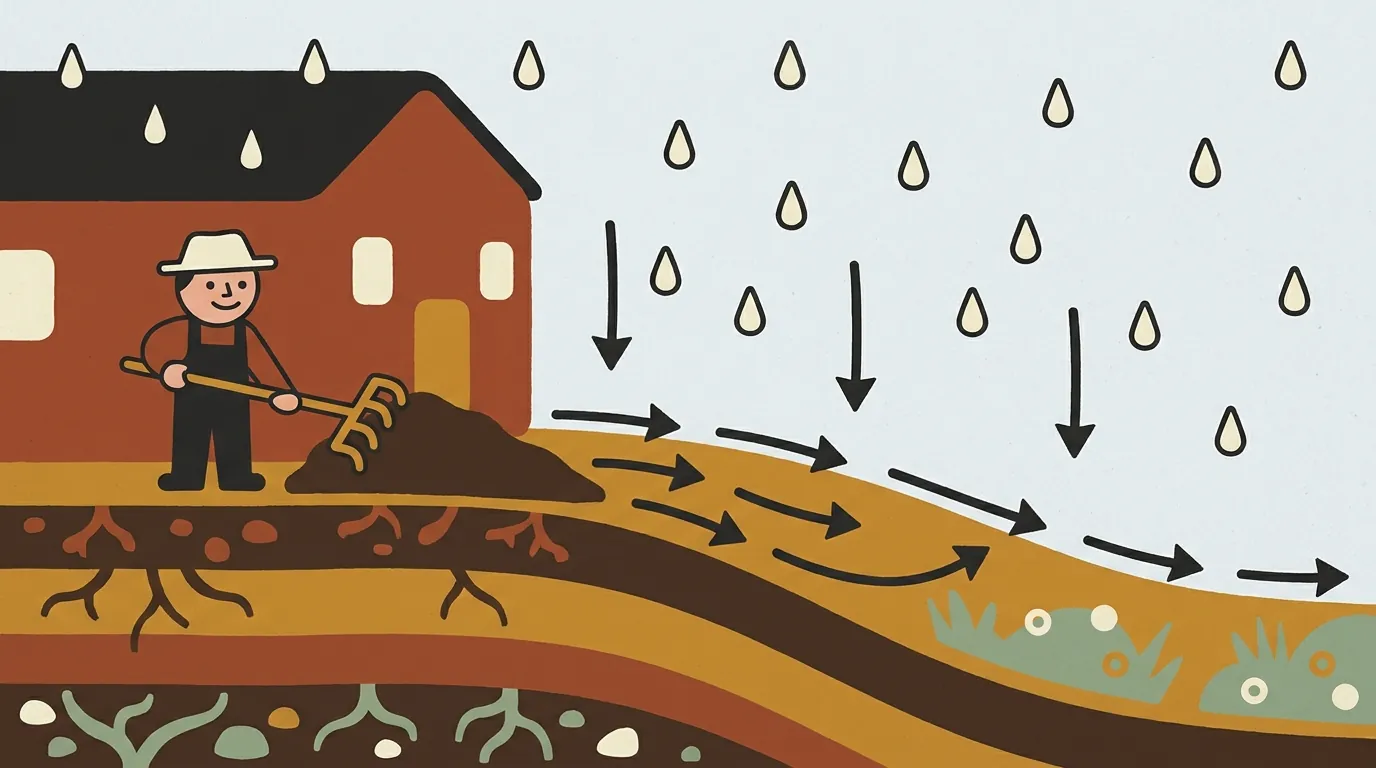
Water that pools against a foundation finds its way into basements and crawl spaces. The usual fix is to grade the soil so it falls away from the house. The International Residential Code, which many US towns adopt, calls for the ground to drop at least 6 inches in the first 10 feet from the foundation (about a 5% slope). Your local code may differ, so check it, but it is a sensible target for most homes.
Keep the soil below the siding as you build it up. Codes commonly call for several inches of clearance between finished soil and wood siding or framing, so grading should never mean piling dirt over the bottom of the wall. If the yard is already high against the house, the fix may be to dig the high ground down and away rather than add more.
How the wedge calculation works
Soil sloped against a house is a wedge: full height at the wall, tapering to zero where it meets the existing ground.
cubic feet = length along house × distance out × (height at house in inches ÷ 12) ÷ 2
Worked example. The back wall is 40 ft long. You want to raise the soil 6 inches at the wall, tapering to nothing 10 ft out:
- 40 × 10 × 0.5 ÷ 2 = 100 cubic feet
- 100 ÷ 27 = 3.70 cubic yards
- Plus 15% compaction: 4.26 cubic yards
- At about 1.1 tons per yard: about 4.7 tons, one load in a 5-yard truck
Do each side of the house separately, since the amount of build-up needed is rarely the same all the way round.
Wedge volumes for a 10 ft run
Measured volume before compaction, for soil that tapers to zero 10 ft from the wall:
| Wall length | Raise 3 in at the wall | Raise 6 in | Raise 9 in | Raise 12 in |
|---|---|---|---|---|
| 20 ft | 0.93 yd³ | 1.85 yd³ | 2.78 yd³ | 3.70 yd³ |
| 40 ft | 1.85 yd³ | 3.70 yd³ | 5.56 yd³ | 7.41 yd³ |
| 60 ft | 2.78 yd³ | 5.56 yd³ | 8.33 yd³ | 11.11 yd³ |
| 160 ft (whole house) | 7.41 yd³ | 14.81 yd³ | 22.22 yd³ | 29.63 yd³ |
How to grade a yard for drainage
- Find the problem. Watch where water goes in a heavy rain. Low spots near the house and downspouts that dump next to the wall are the usual culprits.
- Call 811 a few working days before digging so buried lines are marked.
- Set a slope line. Drive a stake at the wall and another 10 ft out. Tie a string at the target height at the wall, run it to the outer stake, and level it with a line level. Then lower it at the outer stake by the drop you want (6 inches over 10 ft). The string is your finished grade.
- Measure the gap between the string and the ground at the wall: that is the “raise at the house” for the calculator.
- Strip sod where you are adding more than an inch or two.
- Spread fill in layers and tamp each one, building up to just below the string.
- Top with topsoil and seed or re-lay sod. Make sure downspouts discharge onto splash blocks or extensions that carry water past the graded area.
Leveling a yard
- Shallow bumps and dips (under about an inch): top-dress with a thin layer of soil or a soil and sand mix, spread with a rake or the back of a landscape rake so grass blades still poke through. Repeat over the season.
- Deeper low spots: cut and roll back the sod, fill with soil, tamp, water to settle, top up, and lay the sod back.
- A whole uneven yard: a skid steer or tractor with a box blade can cut high spots and fill low ones. This is cut and fill. The cut dirt swells when dug and compacts when placed, so the balance rarely works out exactly; plan on bringing in or hauling out a little.
Use rectangle mode for leveling a whole area at an average depth, and the excavation calculator for dirt you need to dig out.
Grading changes where water goes, including onto neighbors' property. For serious water problems, steep lots or retaining walls, get advice from a local contractor or engineer, and check local rules before regrading.
Questions people ask
- How much slope should a yard have away from the house?
- A common rule, used in the International Residential Code, is for the ground to fall at least 6 inches within the first 10 feet from the foundation, which is about a 5 percent slope. Check your local code.
- How do I calculate dirt for grading against a house?
- Treat it as a wedge: length along the house × distance out × height at the house ÷ 2 gives cubic feet (height in feet). Divide by 27 for cubic yards and add compaction. A 40 ft wall raised 6 inches tapering to nothing over 10 ft is 100 cubic feet, about 3.7 yards.
- What kind of dirt is best for grading around a house?
- Soil with some clay that sheds water is often used for the slope next to a foundation, with a thin layer of topsoil on top for grass. Very sandy soil lets water soak straight down beside the wall.
- How do I level a yard with dirt?
- For shallow dips under an inch or so, spread a thin layer of soil or a soil and sand mix over the grass and let it grow through, repeating as needed. For deeper low spots, lift the sod, fill and compact the hole, then put the sod back or reseed.
- What is cut and fill?
- Moving soil from high spots (cut) to low spots (fill) on the same site so you buy or haul away as little dirt as possible. Account for swell when the cut dirt is dug and compaction when it is placed.