How the excavation calculator works
- Hole volume (“bank” volume). Length × width × depth for a square hole or trench; 3.1416 × (diameter ÷ 2)² × depth for a round hole. This is the dirt in its natural, packed state.
- Convert to cubic yards. Cubic feet ÷ 27.
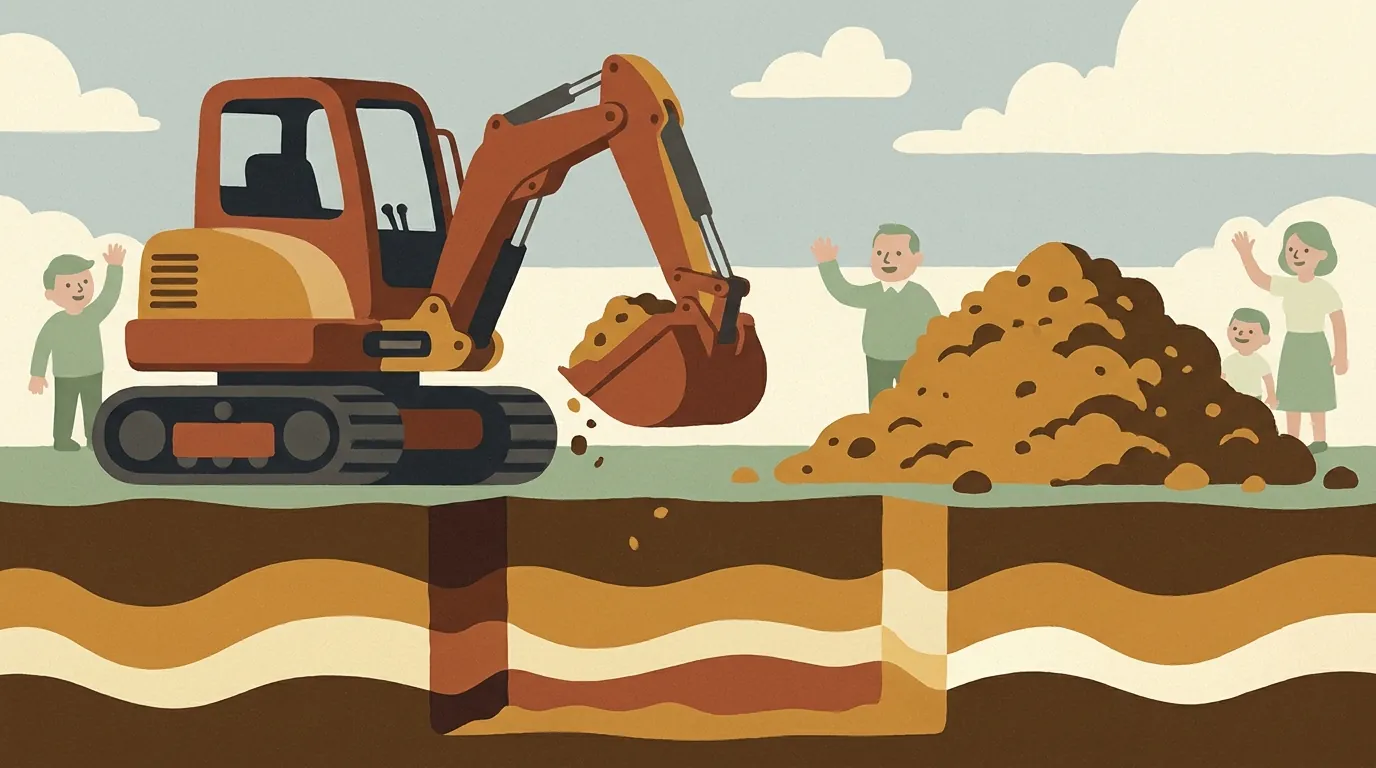
- Add swell. Once dug, the dirt loosens and takes up more room. Multiply by 1 + swell: 1.25 for 25%.
- Count loads. Loose cubic yards ÷ truck capacity, rounded up.
Worked example. A basement-style pit 20 × 12 ft and 4 ft deep:
- 20 × 12 × 4 = 960 cu ft ÷ 27 = 35.6 cubic yards in the ground
- With 25% swell: 35.6 × 1.25 = 44.4 loose cubic yards
- In a 10-yard tandem dump truck: 44.4 ÷ 10 = 4.44, so 5 loads
- In a 5-yard single-axle truck: 9 loads
- At about 1.1 tons per loose yard, that is about 49 tons of dirt
Soil swell: how much bigger it gets
| Soil | Typical swell | 10 yd³ in the ground becomes |
|---|---|---|
| Sand or gravel | about 10–15% | 11–11.5 yd³ loose |
| Common earth, loam | about 20–30% | 12–13 yd³ loose |
| Clay | about 30–40% or more | 13–14 yd³ loose |
| Rock that has been broken out | 50% or more | 15+ yd³ loose |
The calculator starts at 25% for typical mixed soil. Use the lower end for sandy ground and the higher end for heavy clay. These are textbook ranges; actual swell depends on moisture and how the soil breaks up.
Swell going out, compaction going back
The same dirt behaves differently on the way out and on the way back in:
- Dug out: it swells. 10 yards in the ground becomes roughly 12 to 13 yards in the truck.
- Put back and compacted: it shrinks again. Compacted hard in layers, it can end up even denser than it was before you dug it.
So if you dig a trench and put the dirt back after laying a pipe, you usually end up with some dirt left over, even after compaction. That leftover is the volume of the pipe and bedding plus anything that would not compact back. The backfill calculator works the other direction.
Common excavation shapes
- Footing trench. Use trench mode: length of the footing run × trench width × depth.
- Post or pier holes. Use round hole mode for one hole, then multiply by the number of holes. A 1 ft diameter hole 3 ft deep is 2.36 cu ft, so 20 of them is about 47 cu ft or 1.75 yd³ before swell.
- Sloped-side pits. Measure the width at the top and at the bottom and use the average.
- Ponds and irregular holes. Split into simpler shapes, or use the surface area × average depth.
Before you dig
- Call before you dig. In the US, dial 811 a few working days before digging so buried utility lines are marked. It is free.
- Plan where the pile goes. A loose pile from even a modest hole is large. Keep it back from the edge of the hole so the sides do not collapse.
- Trench safety. Deep trenches can collapse without warning. Do not get into an unsupported trench deeper than about waist height; professionals use sloping, shoring or trench boxes.
- Know where the dirt is going. Arrange hauling or a reuse spot before the dig starts.
Swell and weights here are typical ranges for planning. An excavation contractor who has seen your soil can give a firmer number, and the hauler decides how much fits in each of their loads.
Questions people ask
- How do I calculate the volume of an excavation?
- Multiply length × width × depth in feet to get cubic feet, then divide by 27 for cubic yards. For a round hole, use 3.1416 × radius² × depth. That is the volume in the ground; add the swell to get the loose volume you will haul.
- What is the swell factor of soil?
- The extra volume soil takes up once it is dug loose. Typical figures are roughly 10 to 15 percent for sand and gravel, 20 to 30 percent for common earth and loam, and 30 to 40 percent or more for clay.
- How many truck loads will my excavation make?
- Divide the loose cubic yards by the truck's capacity and round up. A 20 × 12 × 4 ft hole is 35.6 yards in the ground, about 44 yards loose with 25 percent swell, so about 5 loads in a 10-yard truck.
- Does dirt weigh more in the ground or loose?
- The total weight does not change when you dig it up, but each cubic yard of loose dirt weighs less than a cubic yard of the same dirt in the ground, because the air gaps add volume.
- Where can excavated dirt go?
- Back into the job as backfill, elsewhere on the property to raise or grade low areas, or off site. Some haulers and fill sites take clean dirt and some charge to accept it, so ask before you dig.