How to work out the fill for a pool
Pools have a shallow end, a deep end and a slope between them, so use the average depth:
- Measure the length and width of the inside of the pool.
- Measure the depth at the shallow end and at the deep end. For a simple sloped pool, average them. If the deep section is short, weight the average toward the shallow end.
- Multiply length × width × average depth for cubic feet, and divide by 27 for cubic yards.
- Add about 20% for compaction. Fill placed in a deep hole needs to be compacted in layers, and a deep fill that is not compacted will keep sinking for years.
Worked example. A 16 × 32 ft pool, 3.5 ft at the shallow end and about 6.5 ft at the deep end, so roughly 5 ft average:
- 16 × 32 × 5 = 2,560 cu ft ÷ 27 = 94.8 cubic yards
- Plus 20%: 113.8 cubic yards
- At about 1.1 tons per yard: about 125 tons
- In 10-yard tandem trucks: 11.4, so 12 loads
For a round above-ground pool that has left a dished hole, use round hole mode with the diameter and average depth of the hole. For a kidney or freeform pool, measure it as a rectangle a little smaller than its longest and widest points.
Pool volume quick table
Measured volume before compaction, at a 5 ft average depth:
| Pool size | Cubic yards at 5 ft average | With 20% compaction |
|---|---|---|
| 12 × 24 ft | 53.3 | 64.0 |
| 14 × 28 ft | 72.6 | 87.1 |
| 16 × 32 ft | 94.8 | 113.8 |
| 18 × 36 ft | 120.0 | 144.0 |
| 20 × 40 ft | 148.1 | 177.8 |
If part of the old pool stays in the hole as broken concrete rubble, it takes up some of the volume, so you need less fill. Ask the contractor how much of the shell will be broken up and left.
How filling in a pool is done
The details depend on the contractor and local rules, but a typical fill-in follows these steps:
- Permits and utility checks. Many towns need a permit. Gas, electric and water lines to the pool are disconnected and capped.
- Drain the pool following local rules for where pool water can go.
- Break the floor. Holes are punched or the floor is broken up so water can drain through instead of collecting in a buried bowl.
- Remove the top of the walls. In a partial removal, the walls are typically demolished down to some depth below the future ground level. Local rules may set that depth.
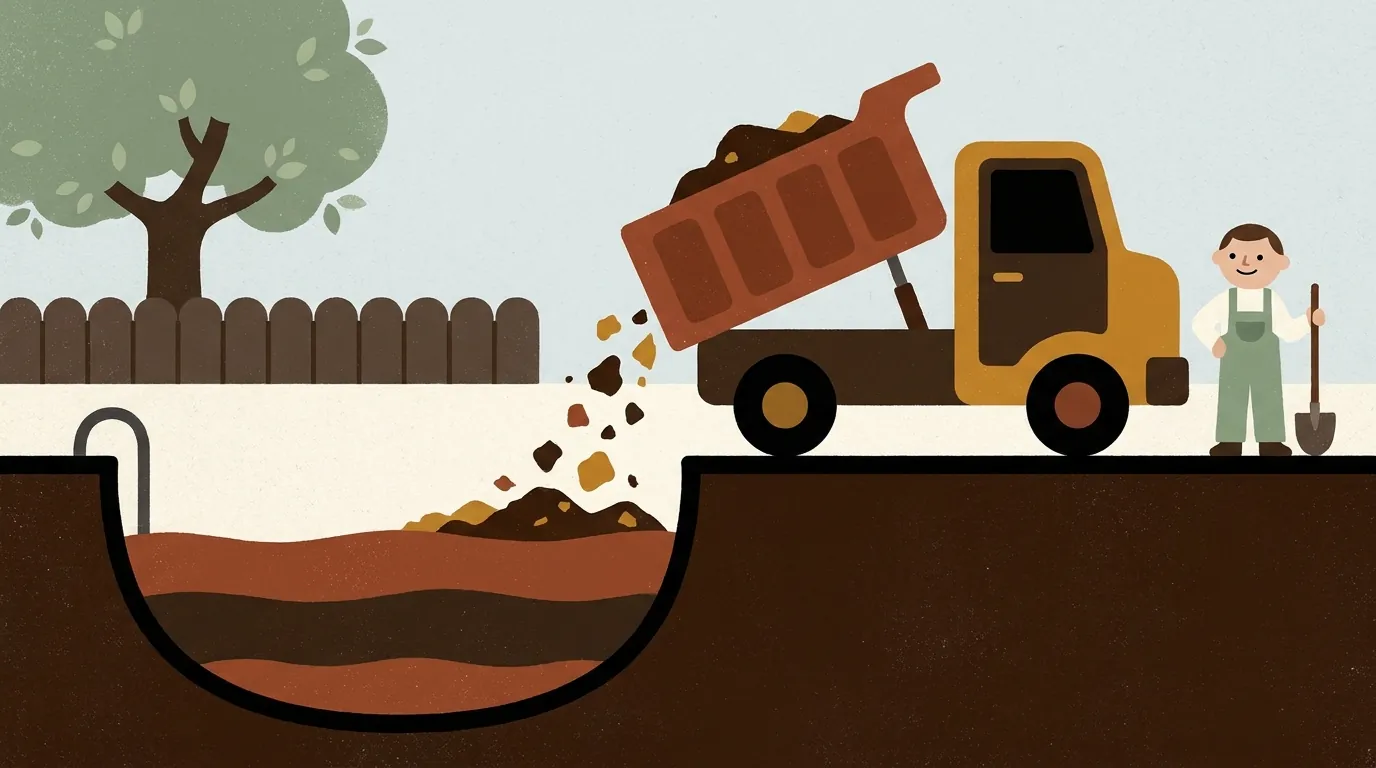
- Fill in layers. Drainage stone may go in first, then clean fill compacted in lifts, often with a machine.
- Topsoil and finish. The last few inches are topsoil, then seed, sod or landscaping.
What drives the cost of filling in a pool
There is no one national price, and any figure you see quoted elsewhere will not include your access, soil or town. These are the parts of a quote to compare:
| Part of the job | What moves it up or down |
|---|---|
| Removal type | Partial removal (fill in place) costs less than taking out the whole shell. |
| Pool type | Concrete or gunite shells take more demolition than vinyl-lined or fiberglass pools. |
| Fill volume | Bigger and deeper pools need more yards and more truck loads; use the calculator to check the quote’s yardage. |
| Hauling | Debris going out and fill coming in are both charged by the load or ton, and distance matters. |
| Access | Machines need a path into the yard. Tight access means smaller machines and more time. |
| Compaction and testing | Some jobs need an engineer’s plan or compaction tests, especially if something may be built there later. |
| Permits | Fees and required inspections vary by town. |
| Finish | Topsoil, seed or sod, and repairs to fences, decks or lawns damaged during the work. |
Ask each contractor how many yards of fill and how many loads their price assumes. If one quote is far lower, the yardage is the first thing to check.
Things to think about first
- Future plans. If you might build on the spot later, a full removal with engineered, tested fill is usually easier to build on.
- Home sale. In some places a filled-in pool has to be disclosed when you sell. Keep the permit and contractor paperwork.
- Drainage. A filled pool is a large bowl of new soil. Make sure the finished grade slopes away from the house; the yard grading calculator can help with the top layer.
Pool removal rules differ widely by town. Use this page to estimate fill and compare quotes, and check permit, demolition and compaction requirements with your local building department.
Questions people ask
- How much dirt does it take to fill in a pool?
- Length × width × average depth in feet, divided by 27, gives the pool's volume in cubic yards. Add about 20 percent for compaction. A 16 × 32 ft pool averaging 5 ft deep is about 95 yards, or about 114 yards with compaction.
- How much does it cost to fill in a pool?
- It depends on whether the pool is partly or fully removed, how much fill it takes, how far the fill and debris travel, site access, permits and whether an engineer is involved. Get quotes that list each part so you can compare them.
- What is the difference between partial and full pool removal?
- In a partial removal, holes are broken in the floor for drainage, the top part of the walls is demolished, and the pool is filled in place. In a full removal, the whole shell is taken out before filling. Full removal usually costs more but leaves fewer questions for future building or a home sale.
- What do you fill a pool with?
- Commonly a mix of broken pool material and clean fill dirt, sometimes with gravel at the bottom for drainage, then a few inches of topsoil on top. What is allowed varies by town, so check local rules.
- Do I need a permit to fill in a pool?
- In many places, yes. Requirements can include a demolition permit, inspections and compaction testing. Check with your local building department before you start.